Salvador Ibanez (Small Model)

Salvador Ibáñez (1854-1920) was a Spanish
luthier. He made guitars, ukuleles, mandolins
and other stringed instruments. These
instruments were considered the finest of
their age and are prized for their excellent
quality and impeccable workmanship.
At eleven years of age Ibáñez became an
apprentice in guitar construction at Calle Muela
Valencia. In 1870 he started his own company:
Salvador Ibáñez y Albiñara.
apprentice in guitar construction at Calle Muela
Valencia. In 1870 he started his own company:
Salvador Ibáñez y Albiñara.
The company was registered at Calle Cubells.
Working in his shop were the ten-year-old
José Ibáñez and Magdalena Albiñara y
Magraner, from Ollería, Valencia.
Working in his shop were the ten-year-old
José Ibáñez and Magdalena Albiñara y
Magraner, from Ollería, Valencia.
In 1896 he first appeared in the trade guides at
Calle Ruzafa Valencia and from 1898 to 1906
his shop was located at Calle Bajada de San
Francisco. Salvador Ibáñez made bandurrias,
lutes, six and nine-string guitars and also
guitars with detachable necks. In 1897 he
made the world's first double-necked guitar.
Calle Ruzafa Valencia and from 1898 to 1906
his shop was located at Calle Bajada de San
Francisco. Salvador Ibáñez made bandurrias,
lutes, six and nine-string guitars and also
guitars with detachable necks. In 1897 he
made the world's first double-necked guitar.
In the period 1915-20 Salvador Ibáñez e Hijos
(Salvador Ibáñez and Sons) were located at
Calle Bajada de San Francisco and at Calle
Padre Rico Valencia. When he died in 1920
his workshop continued to be managed by
his two sons until it was completely destroyed
during the Spanish Civil War (1936-1939)
in a bloody street fight, which cost the lives
of many of the personnel.
This was THE story up until now, however one of
my friends visited Madrid in order to meet some
colletors there and it became clear that at least one
of the sons of Salvador Ibanez didn't die in the civil
war and that the factory and its' machines were sold
to Telesforo Julve. A picture of a graveyard stone
from one of the sons from S. Ibanez attests:
DON SALVADOR IBANEZ SALABERT
DIED 21 abril 1967
A LOS 80 ANOS
R.I.P.
After the Salvador Ibáñez workshop had
(Salvador Ibáñez and Sons) were located at
Calle Bajada de San Francisco and at Calle
Padre Rico Valencia. When he died in 1920
his workshop continued to be managed by
his two sons until it was completely destroyed
during the Spanish Civil War (1936-1939)
in a bloody street fight, which cost the lives
of many of the personnel.
This was THE story up until now, however one of
my friends visited Madrid in order to meet some
colletors there and it became clear that at least one
of the sons of Salvador Ibanez didn't die in the civil
war and that the factory and its' machines were sold
to Telesforo Julve. A picture of a graveyard stone
from one of the sons from S. Ibanez attests:
DON SALVADOR IBANEZ SALABERT
DIED 21 abril 1967
A LOS 80 ANOS
R.I.P.
been destroyed and with the Salvador Ibáñez
guitars not being available (and very much
sought after due to their excellent quality),
the Japanese distributor Hoshino Gakki
decided to start making Ibáñez guitars of
their own after years of importing Salvador
Ibáñez guitars to Japan. They purchased
the trademark and started production, first
naming the guitars "Ibanez Salvador" and
later Ibanez which obtained great success
in the 1970s and 1980s.
guitars not being available (and very much
sought after due to their excellent quality),
the Japanese distributor Hoshino Gakki
decided to start making Ibáñez guitars of
their own after years of importing Salvador
Ibáñez guitars to Japan. They purchased
the trademark and started production, first
naming the guitars "Ibanez Salvador" and
later Ibanez which obtained great success
in the 1970s and 1980s.
Hoshino Gakki currently produces both
acoustic and electric guitars using the Ibanez
brandname and is oriented at all kinds of
devices for electric guitars and basses.
acoustic and electric guitars using the Ibanez
brandname and is oriented at all kinds of
devices for electric guitars and basses.
Julian Bream has played a Salvador Ibáñez
guitar. Eric Clapton has owned several original
Salvador Ibáñez guitars, one of which was sold
at a benefit auction in 1999 at Christies,
obtaining a final price of $42,000 USD.
The guitar was estimated between 3000 and
5000 USD what can be considered a fair
price on an auction. Regarding history it is
curious to discover that the first quality guitar
played by Francisco Tarrega was a Salvador
Ibanez before he switched to the Torres
guitar. A picture of Tarrega with a Salvador
Ibanez guitar seems to be around somewhere...
guitar. Eric Clapton has owned several original
Salvador Ibáñez guitars, one of which was sold
at a benefit auction in 1999 at Christies,
obtaining a final price of $42,000 USD.
The guitar was estimated between 3000 and
5000 USD what can be considered a fair
price on an auction. Regarding history it is
curious to discover that the first quality guitar
played by Francisco Tarrega was a Salvador
Ibanez before he switched to the Torres
guitar. A picture of Tarrega with a Salvador
Ibanez guitar seems to be around somewhere...

As opposed to the front, the back looks
much better and indeed hardly any cracks
and that counts for the sides as well.

A nice shot of the brasilian rosewood back though
on some pics it may look a bit otherwise due to
necessary moves in a Photo program.

Dirty and still not taken care for on this picture
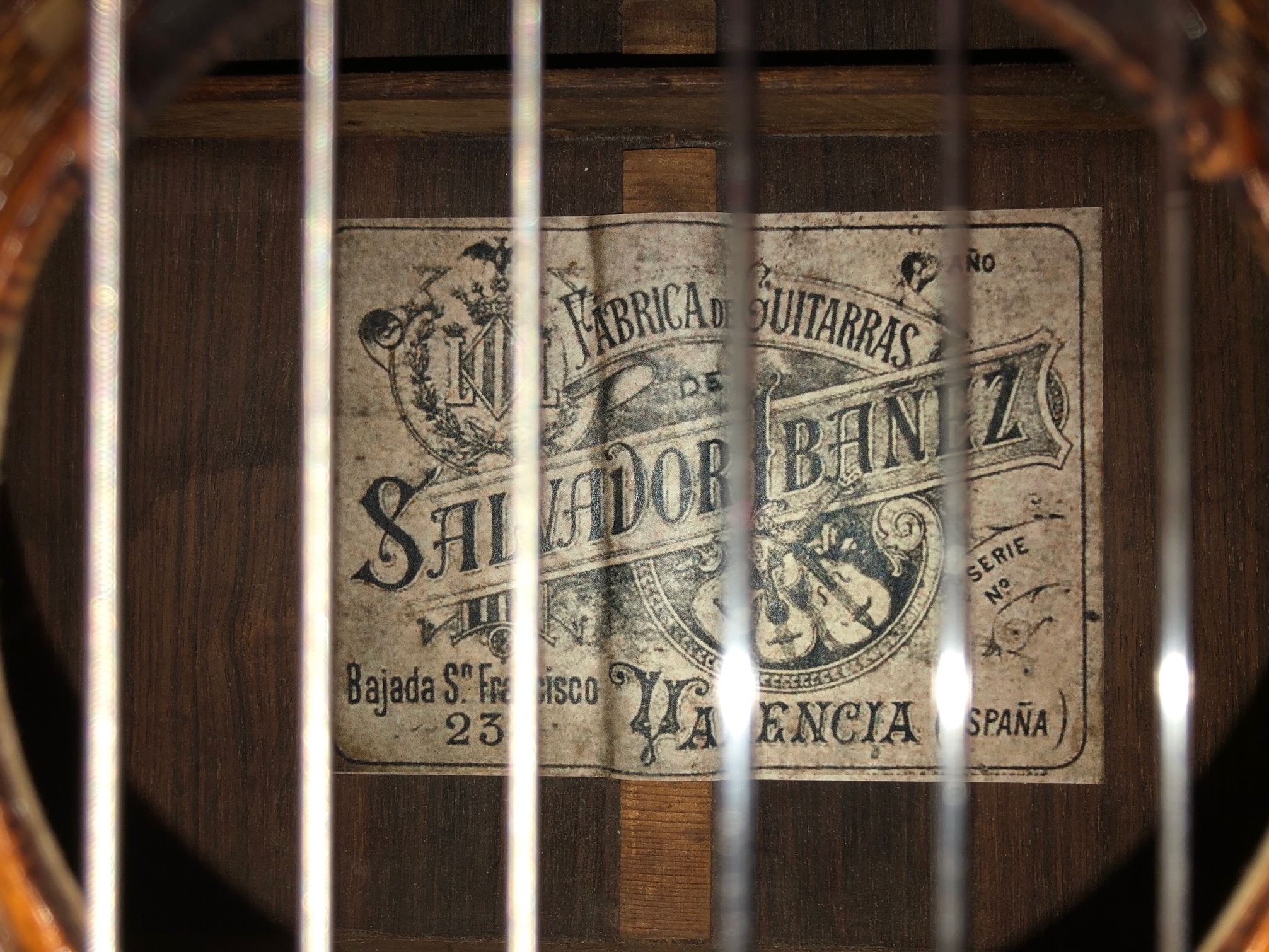
but clearly visible is the Bajada de San Francisco
label and not Salvador Ibanez e Hijos from the
later period.

This guitar literally came in parts but as often happens the
so called cracks in the sound board were no more than the
seams of the parts the guitar was showing. Bigger problem
was the edge lining as that was existing of multiple layers

The label can be dated around 1900. Luckily other investigators
have found this information sometimes even by frequently visiting
Valencia and surroundings.

The typical placing of the individual blocks to support the
soundboard can be studied here as is the fan bracing that
only exist of three small bars. Only two transverse bars on
the soundboard. In the bigger models a double transverse
bar is placed above the sound hole thus preventing cracks
alongside the fingerboard after some time.

Luckily you are able to study the right bridge model
for these guitars by searching on the internet. Sometimes
people are willing to share their knowledge, sometimes
not. It is my experience that once you do that you will
get it back, one way or the other.

The two typical pearl inlays in the bridge, Telesforo
Julve was later known for was already there when
Salvador Ibanez was in charge as is the headform,
that sometimes also can be found on Francisco Pau
and Jaime Ribot guitars (???) You can also detect
the lighter colour part in the bindings around the
soundboard. Those were missing. A hell of a job to
restore that as each layer measures about 0,3 mm
in width. Sometimes you get the remark that you
are making much profit on guitars like this but let's
not forget that it takes hours, days and in fact weeks
before a guitar is playable again.

The coloring is not the most difficult process. Water
stained products can be even thinned with water to
your liking thus making it possible to catch the exact
colour. On a soundboard things are different alas.

A nice and well preserved back that only needs some
varnishing or French polishing.

The typical way of placing the glue blocks for the
soundboard to the sides can be studied here. I have
only sen this in Salvador Ibanez guitars but chances
are that it could have been more widely used.

The two missing ribs of the fan bracing can be copied easily.
And the traces of the old ones will hel to glue them in the
correct place. The seams of the 3 piece soundboard can be
seen here from the inside. Salvador Ibanez often did this and
Telesforo Julve used this way of constructing as well.

I'll include some detail pictures for others to investigate
some specific building marks in other guitars.

This was the point where to start from regarding glue work.

Of course there are good constructions to be had
in gluing the braces but this method works as well
especially when it is not a "daily job" for you.

Nearly ready to close the guitar again...
This label is dating the guitar in charge quite exactly:
The label has been used in the period 1898 - 1902.

Here you are able to check the dimensions of these smaller guitars.

The dimensions of the new bridge as the original
was missing. Made out of ebony.

And the soundboard construction aas developed by Ibanez.
After the lacquer treated process and ready to use.

The tuners that work in a normal way with their
copper shafts. The plastic or bone rollers were
a much later addition.

And the wurm placed before the wurm wheelas
was common in the early years of the twentieth
century until about the period 1910 -1920.
Salvador Ibanez "Concert" model appr. 1908.

I'd like to start with the end result: The guitar as
it is now. Great bonus was the awesome tone!
Scale: 650 mm. Width at topnut: 52 mm.
Width at the bridgebone: 59 mm.
A newly added label. I'll explain this decision
further in my explanation.

The back that has been French polished as is the rest of
this guitar.

Only two small inserts in the centre of the bottom
were needed. Hardly detectable now.

As the back had to be taken off a new binding of course.

The soundboard, still absolutely straight before
and behind the newly glued bridge.

Half of the original frets were missing so a new fret job
was necessary. Also to change the angle neck to body.

Some mother of pearl pieces were missing. Newly added
of course. The two triangular inlays on both sides of the
bridge are not in line. Remarkable but I've seen this more
on Salvador Ibanez guitars!

The head with its' inlays. Again in a like new condition.

No damages to the back of the head. Not any cracks
here. Original tuners as well.

The typical Valencian way of building a heel.

In fact photographed to show the action. This guitar
is very comfortably playable now with its' 4,5 mm action
on the 6th string (twelfth fret) and 3 mm on the first.

Maybe even lower for the first string. A joy to play!

Just a nice shot but also to show the inserts alongside
the left and right side of the fingerboard though this
often occurs on older guitars.

A Brasilian rosewood fingerboard as opposed to the later
used ebony when Salvador Ibanez e Hijos were in charge
on their highest models.

All the repaired cracks can be seen here. I've left the
inserts just a bit higher so a luthier very experienced
in coloring the insert might do a better job.

The bridge already was partly loose and having seen the knob
for a strap (I do not know wether if this is original?) and
the holes for a string holder I presume someone putted on
a set of metal strings!

A beautiful rosette but in fact carved a bit too deep in
the soundboard. Therefore I strengthened the inner part
of the sound hole to prevent any future damages. That
can be removed but is not advisable.

I took the opportunity to remove the bridge a bit further
away from the sound hole to ensure a perfect octave pitch!

The knob for the G-string is a bit bowed but works perfectly.
Dangerous to have it placed back in the "start" position so I
left it that way as it works normally.

The guitar in question in unrestored condition.
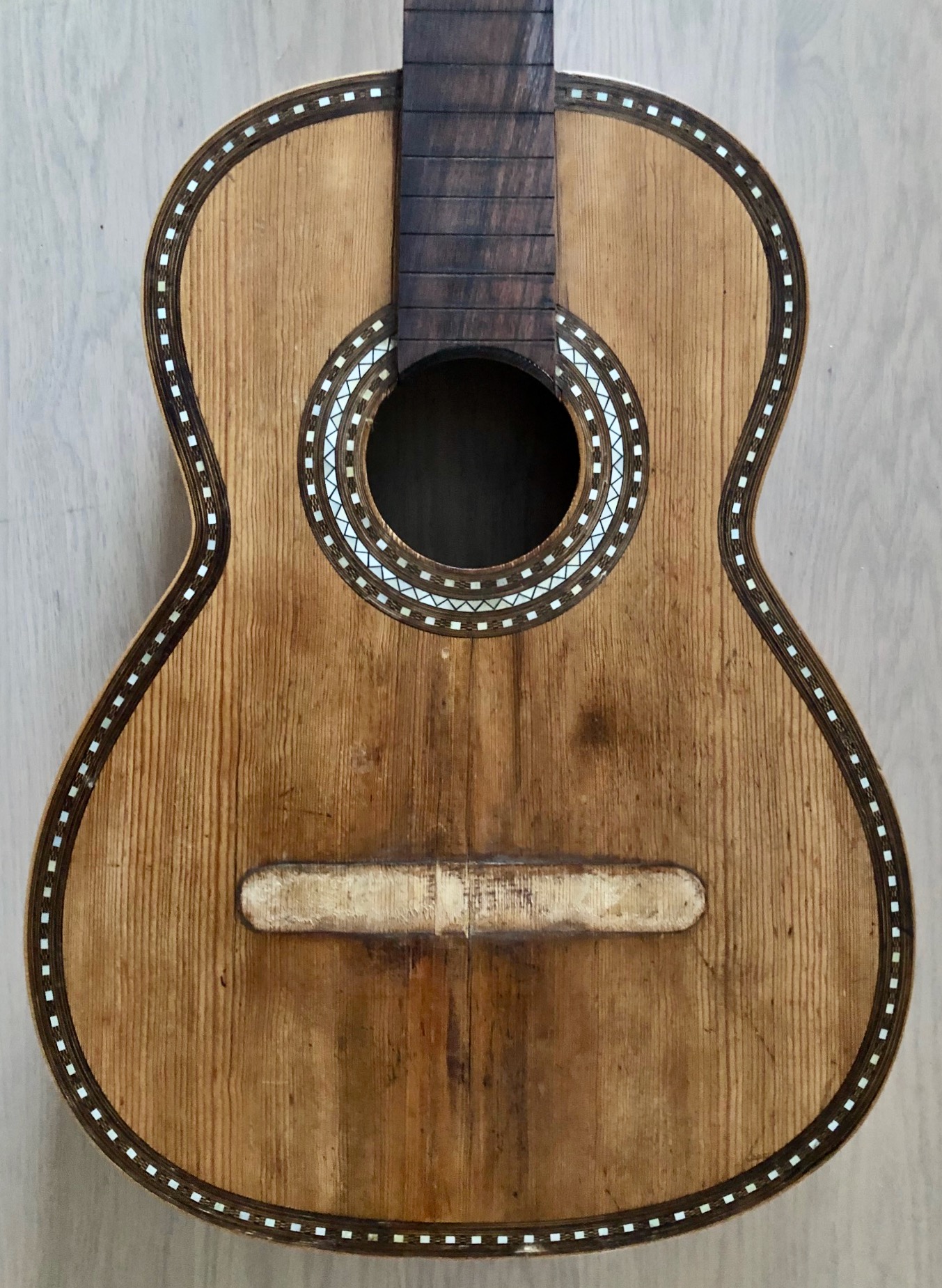
A body close up with the frets already removed.

Similarities with a Jaime Ribot guitar. But also with a Francisco
Pau guitar. It would have been easy to place a label in this guitar
from these luthiers but to be honest: everything points towards
Salvador Ibanez as I already explained here and there.

The Jaime Ribot guitar and other builders appear to
have similar ornamentations as on guitars of some other
Valencian makers they can be seen: Francesco Pau
and of course Salvador Ibanez.

The Jaime Ribot label, a bit damaged.

Again, but now with the strings in between. You can easily
make pictures with your mobile telephone by simply sliding
your telephone below the strings and then make a picture.
These pictures are NOT from the guitar in question!

The guitar presented with the bridge off as it was
easy to remove it. It was already partly loose.

The body before the crack repairings took place.

The label that should have been in this guitar. Photographed
and shopped to make it clearer thus giving more details.

This label must have been used between 1905 - 1910.

Some reparations (inserts) were needed and therefore
the back has to be French polished from the start.

A knob at the bottom intended for use with a holding
strap. Wether if this is original can be discussed of course.
The holes a bit higher placed are the traces of a formerly
placed tailpiece, probably for metal strings...

The inserts, still not colored to their surrounding.

Strange is the unevenness of the inlays on both sides of the
string tie block. I've noticed it on other guitars from Ibanez
guitars of that period. The inserts necessary can be studied
here. More easy to do that without the bridge glued on.

The head and the newly placed frets as half of them were
already missing and moreover, I had to make a neck to
body angle correction. For that purpose I shaved away
material of the fingerboard towards the head.

I've shortened the headstock with about 1 mm in order
to get rid of disturbing damages that occur when placing
a guitar frequently with its' head against a wall.

A new quality topnut that has to be
there on a concert guitar of this age.

Though the back has been taken off, a picture with the
label sticked in from the sound hole has to be there.

This happens so often! In this case the two transverse braces
were partly loose and then string tension can cause these
problems much easier. To prevent this in the future I placed
an extra wide but thin layer between the two transverse bars
in the upper bout. The Japanese do this often to prevent
these damages.

Another move was to strengthen the soundhole
edges as when the space for a rosette is carved too
deep it severely weakens that spot. The cleat
beyond has been placed at the end of a crack.

Every single glue block that attach the soundboard to
the sides must be checked and reglued if necessary. The
transverse bars above the sound hole had to be reglued.

And the same insert on the other side.
A knob at the borttom intended for use with a holding
strap. Wether if this is original can be discussed of course.
The holes a bit higher placed are the traces of a formerly
placed tailpiece, probably for metal strings...
The head and the newly placed frets as half of them were
already missing and moreover, I had to make a neck to
body angle correction. Fo that purpose I shaved away
material of the fingerboard towards the head.

No spruce heel operation, often done by Valencian
makers to speed up production processes.

And a picture of the other side of course.

The new added bindings around the back.

New proper fretwork.

A nice shot of the ornamentation and the Brazilian
rosewood fingerboard used here.

The insert on the right can be studied here.

Inserts coloured a bit better...

The beautiful rosette with some newly placed
pieces of pearl inlay.

The sides that are in pristine condition.


